Your Cart is Empty


November 04, 2026
Across the Pyrenees with Runa and Thomas
With strict off-road restrictions, rules, and regulations spreading through many countries across Europe, Norway included, we found ourselves looking south for this year’s adventure. Rumors and promises of endless off-road options, spectacular mountain views, peaks rising above 3,000 metres, good weather, good food and good people. It had to be good. But would it be good enough to justify riding 2,500 kilometres, including some detours, from Norway to reach the start of the actual trip? We were about to find out.


Our plan was, as always, to have no real plan, other than taking one day at a time. In fact, we had deliberately avoided doing too much research beforehand. We didn’t want to know exactly what was waiting around every corner. We had collected a handful of routes, GPX tracks, and POIs, with the ACT and TET as our starting points. The general idea was simple: ride from east to west and see where the road or, preferably, the trail took us.

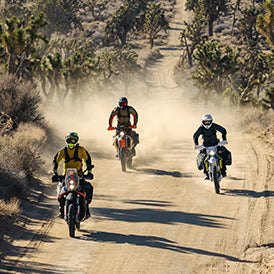
It didn’t take long before the mountains started building in the distance. Our route offered a bit of everything in terms of surfaces. Simple dirt roads, narrow winding tarmac complete with large potholes, rocky sections, washouts, and loose, rolling gravel. We crossed paths with plenty of riders out there, from guys wrestling fully loaded GS 1300s with dented aluminum boxes to lightweight enduro setups. The one thing everyone had in common was that shared, dusty grin you only get from a road that fights back a little.

The routes often dipped back down into charming little villages, many of them filled with impressively old stone buildings. They looked like places that would be buzzing with life in the summer, with little restaurants, cafés, shops, and accommodation scattered along the streets. But in September, most of them felt almost completely abandoned. Grocery shops were often few and far between, so we quickly made it a habit to stock up for the entire day whenever we passed one. We would have loved to try more of the local food along the way, but there is one advantage to cooking your own meals: you can eat wherever you want. And when “wherever you want” happens to be a quiet mountainside with an incredible view, you really can’t complain.


Finding somewhere to pitch the tent
Finding a campsite at the end of the day was generally pretty easy. What did catch us by surprise, though, was how early many of them closed their reception. Some stopped taking guests as early as 5 p.m., effectively cutting a few hours off our riding days, hours we would have happily spent exploring.
“But why not just wild camp?” I hear you ask. Believe me, we would have loved to. There were more than enough beautiful places where pitching a tent would have been tempting. The problem was that the rules around wild camping were, well… a little unclear. They seemed to vary depending on where you were, the altitude, how early you pitched your tent, when you packed up and left in the morning, and probably a few other things we never quite figured out. Would we have gotten away with it? Probably. But since we were documenting the trip for our YouTube channels, we also had to think about the kind of behavior we were promoting. It’s one thing to quietly bend a rule when nobody is watching. It’s another thing to put it on the internet and potentially encourage thousands of people todo the same. So we took the safer option and stuck to campsites.


 We took our sweet time making our way across the Pyrenees from east to west, spending most of our time on the Spanish side, with a few loops taking us into France and through Andorra. Andorra probably gave us the cheapest fuel of the entire trip. Being a tax-free country, fuel prices were noticeably lower than what we had seen elsewhere. Ironically, though, it also ended up being the country where we spent the most money, mainly because we managed to crash a drone and lose a DJI microphone somewhere along the bumpy way.


In total, it took us around ten days to cross the mountains before eventually reaching our westernmost point, just north of San Sebastián on the Bay of Biscay. The weather was remarkably kind to us for most of the journey, with clear skies and plenty of sunshine. Temperatures, however, covered pretty much the entire range you could ask for in one day: from around 4°C in the early mornings to close to 40°C later in the afternoon, and just about everything in between.
A little room to spare
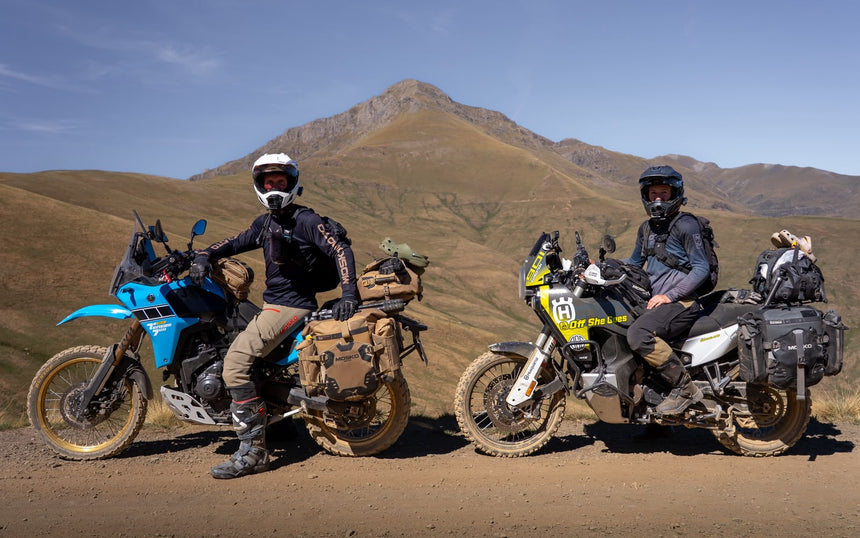
Our luggage setup worked like a charm for this trip. Thomas opted to upgrade to a higher capacity luggage kit, something I had spent most of last season trying to convince him he needed. Although, to be fair, he mostly convinced himself after seeing how easily I could pack my gear, while still having plenty of room left for the day’s groceries, a rain jacket, or an extra layer when the weather warmed up. Thomas’s previous setup meant playing a daily game of Tetris, with every item having its own specific place and everything fitting together just so. It worked perfectly well, but once everything was packed, there wasn’t much room left for anything extra.

With our current setup, we have a little more flexibility, which proved particularly useful on a trip with such large temperature swings. As the day warmed up, we could simply shed a layer or two and tuck them into the panniers rather than strap them to the outside of the bike. It might sound like a small thing, but having somewhere clean and protected to put those extra layers makes a noticeable difference over a long day on the road. No dusty jacket flapping around on the outside, no extra gear getting in the way, and nothing exposed if the bike takes an unexpected nap.
It’s those little practical details that make life on the road just that bit easier.
So when a stranger looked over our bikes: a Ténéré 700 Rally and a Norden 901 Expedition, both with fully loaded luggage, you can almost see the follow-up question forming in his mind. The one he’s probably too polite to ask out loud: “What the heck do they even carry in all that luggage?”

The unspoken answer is essentially everything two people need to be self-sufficient on their motorcycles for a month, camp every night, cook their own meals, and shoot video content along the way.
So, did we take those bikes on that road? Yes, we did. And perhaps that’s what we like about this kind of travel. You don’t have to make things unnecessarily difficult by carrying more than you need, but you also have to be ready for whatever the road throws at you.
The Pyrenees gave us exactly the kind of adventure we were looking for. Tough enough to be memorable, comfortable enough to keep enjoying it. And for us, that’s a pretty good combination.
Words by Mosko ambassador Runa Grydeland, photos by Runa and Thomas HansenYou can follow Runa and Thomas on more moto adventures via Instagram and YouTube.Runa:Instagram /YouTubeThomas:Instagram /YouTube
Want to know more about Runa's gear setup for this trip? See more in the video below.
Comments will be approved before showing up.